BFD Static Route Tracking on HPE Comware v7
How to use BFD echo mode with static route tracking on HPE Comware v7 for fast failover between primary and backup static routes without requiring BFD support on the remote peer.
How to use BFD echo mode with static route tracking on HPE Comware v7. When the primary path fails, BFD detects it rapidly and the tracked static route is withdrawn, activating the backup.
BFD echo mode does not require BFD support on the remote peer — packets loop back through the remote device, so this works with any upstream equipment.
Track is a detection module in Comware that reports positive or negative based on interface status, link status, reachability or performance. Here it’s paired with BFD to watch a remote IP, and static route preferences change the routing table when the far end becomes unreachable.
I’d have preferred OSPF, but there were firewalls in the path that I had no control over, and the backup link was ADSL. I proved the design in a lab first. For the full background on Track, read HPE’s Comware High Availability configuration guide.
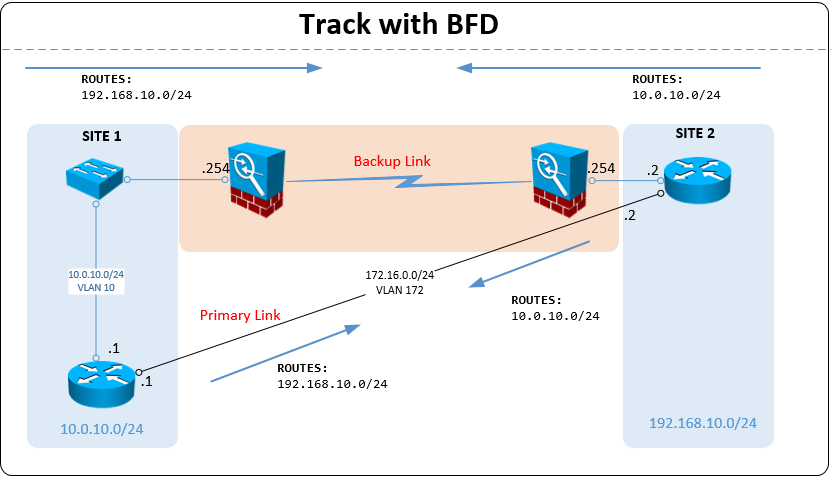
Scenario #
Two sites on a primary link (VLAN 172) with a backup path. Each site tracks the primary link; if BFD fails, the primary static route is removed and the backup (higher preference) becomes active.
Site 1 #
bfd echo-source-ip 172.16.0.1

track 1 bfd echo interface Vlan-interface172 remote ip 172.16.0.2 local ip 172.16.0.1

ip route-static 192.168.10.0 24 172.16.0.2 track 1
ip route-static 192.168.10.0 24 10.0.10.254 preference 65
Site 2 #
bfd echo-source-ip 172.16.0.2

track 1 bfd echo interface Vlan-interface172 remote ip 172.16.0.1 local ip 172.16.0.2

ip route-static 10.0.10.0 24 172.16.0.1 track 1
ip route-static 10.0.10.0 24 192.168.10.254 preference 65
How it works #
- The primary static route includes
track 1— active only while BFD is up - The backup route has
preference 65— higher number means lower priority in Comware (default is 60), so it only activates when the primary is withdrawn - The backup preference must be above 60 to avoid competing with the primary